

Hey there, curious reader! Have you ever stopped to wonder about the backbone of many industries, from aerospace to oil and energy? I’m talking about metalworking, a field that’s as robust as it is essential. Today, we’re unpacking the vital differences between two major players in the metalworking game: machining and fabrication.
First off, let’s give a shoutout to CT Products, a standout among machine and fabrication shop services. Their expertise in delivering high-quality precision parts using the latest equipment is nothing short of impressive.
They’re trusted by industries spanning industrial manufacturing, mining, steel production, warehousing, conveyor systems, oil, energy, and even aerospace! Now, buckle up as we explore what makes machining and fabrication oh-so-different yet equally fascinating.
Core Process Differences: Machining vs. Fabrication
Alright, let’s break it down. You might be wondering how machining and fabrication differ at their core. In simple terms, machining is like a sculptor chiseling away at a block to create something exquisite, a subtractive process if you will. On the flip side, fabrication is more of a constructive endeavor, like assembling a puzzle – it’s all about forming and joining, an additive and formative process.
Machining Process Details: Precision in Every Cut
Imagine starting with a solid hunk of material, like a billet or rod. Machining methods, including milling and turning, carve out precisely what’s needed, much like whittling a piece of wood.
Tools like lathes, mills, drills, and grinders get into action here, often using CNC machines to achieve those incredibly tight tolerances. We’re talking precision down to thousandths of an inch, perfect for detailed features like gears, shafts, and even engine components.
Verifying that level of precision is its own engineering problem. A machine vision lens with the right magnification and working distance lets the inspection camera resolve features down to a few microns, which is the only way to confirm a CNC-machined gear actually hit its drawing tolerances rather than just looking right to the eye.
Fabrication Process Details: From Sheets to Structures
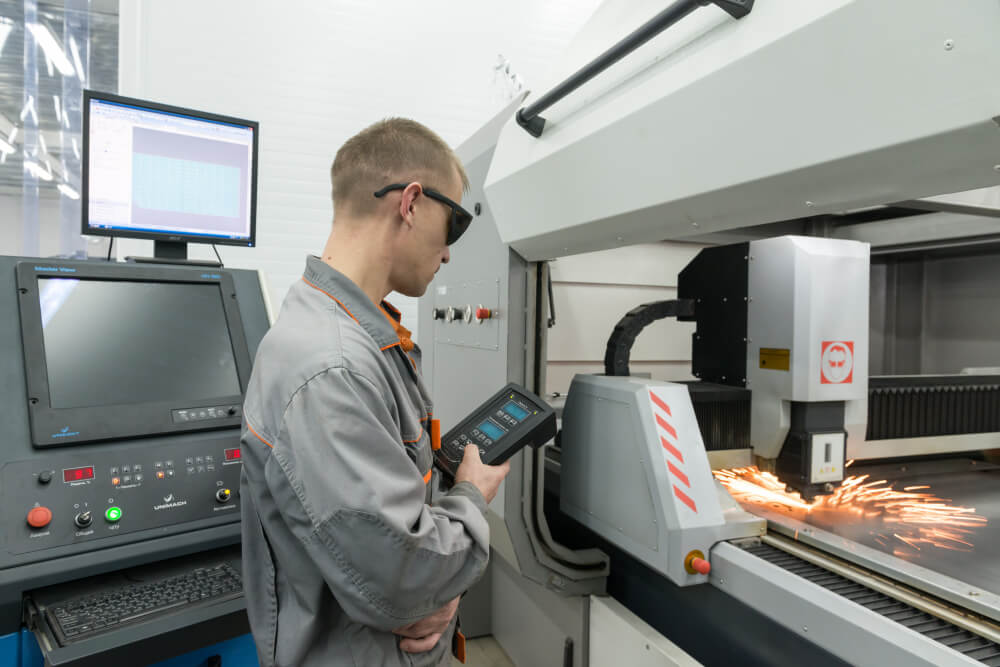
Now, slide over to fabrication. It kicks off with materials such as sheet metal and structural beams. This process is all about shaping and joining, with techniques like bending, punching, and welding in the spotlight.
It’s about creating something new, using tools like press brakes and laser cutters. Think of products like enclosures, frames, and brackets—it’s these kinds of assemblies that fabrication loves to build, efficiently and often in high volumes.
Choosing the Right Process: Machining or Fabrication?
Here’s the thing: Choosing between machining and fabrication depends on what you need. Picture a scenario where you require parts with precise geometries and ultra-fine details—machining is your go-to. But let’s say you need large and sturdy structures built quickly—that’s where fabrication shines. So, whether it’s machining or fabrication, each has its own charm depending on the project’s needs.
Advantages and Limitations: When to Use Which
Now, let’s talk perks and pitfalls. Machining is awesome for low-volume, high-precision tasks, yet it’s slower and can generate more material waste. Fabrication, however, is a champ for high-volume projects, especially those needing structural soundness, but doesn’t hit the same level of precision. So, choosing wisely can make all the difference!
Integration and Advanced Techniques: Where Worlds Collide
Here’s where things get really cool—automation and CNC technology can take both processes to the next level. Imagine combining machining’s finesse with fabrication’s robustness for complex projects. It’s like mixing the best of both worlds to craft components that are both detailed and durable!
Conclusion:
So, there you have it! Machining and fabrication might be two sides of the same coin, but they’re packed with their own unique capabilities. Remember, next time you’re embarking on a project, take a moment to consider what you truly need—precision, scale, or maybe a bit of both. Whatever the choice, with partners like CT Products guiding the way, you’re in good hands!